






72 hours in the Pays des Abers
Brittany/2026
In North Finistère, the Abers, river valleys invaded by the sea, form deep, narrow inland bays. Subjected to the tides, they make up a mysterious and wild land, where it's good to immerse yourself.
Between land and sea, the Abers not only offer magnificent landscapes, but also constitute an ideal ecosystem for oyster farming. These geographical curiosities, where seawater meets freshwater, provide the perfect nutrients for feeding these beloved mollusks, in fairly stable conditions, sheltered from strong swells and wide temperature variations. The Madec family, pioneers of oyster farming in this little corner of paradise, made no mistake when they settled on the shores of Prat-Ar-Coum in 1898, where they have been perpetuating their renowned know-how for five generations.
The gastronomic riches of the Pays des Abers are not limited to oyster farming. Breton specialties such as galettes and farz-based dishes are well represented, as are abalone and the many varieties of seaweed that are being farmed and cultivated.
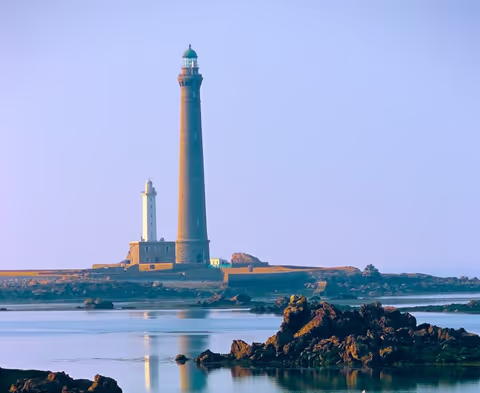
From village to village, you'll discover this welcoming land with its many sights, churches and chapels, windmills and lighthouses, the most extraordinary of which is Île Vierge, the highest in Europe. Start your journey in Lesneven, a typical Breton town that was once the capital of Léon, appreciated for its calm and its architectural beauties inherited from the past: the former Ursuline convent dating from the 17th and 18th centuries, whose chapel has been converted into the Léon museum, the church of Saint-Michel and its Renaissance porch, listed as a historic monument, and the many historic houses, some of which date back to the 15th century.
Take your first step towards the sea at Guissény, near the estuary of the small coastal river Le Quillimadec, before returning to Lannilis, right between the two most majestic abers, one called "Benoît" to the west and the other "Lannilis" to the east.one named "Benoît" to the south-west, the other "Wrac'h" to the north-east. Then head for Landéda and Plouguerneau, crossing this marvel of indented coastline. Don't miss the Sainte-Marguerite dunes in Landéda, the view of the Aber-Benoît from the Tréglonou bridge and the picture-postcard scenery of the Lilia archipelago and its crystal-clear waters, watched over by the famous Île Vierge lighthouse. Here and there, sandy beaches alternate with rocks and ancient stones, some of them reminiscent of megaliths. This rich rocky mosaic is revealed by the tides, whose exceptional amplitude is comparable to that of the Bay of Mont-Saint-Michel, for a unique daily spectacle.