






48 Hours on Île de Ré
Nouvelle-Aquitaine/2026
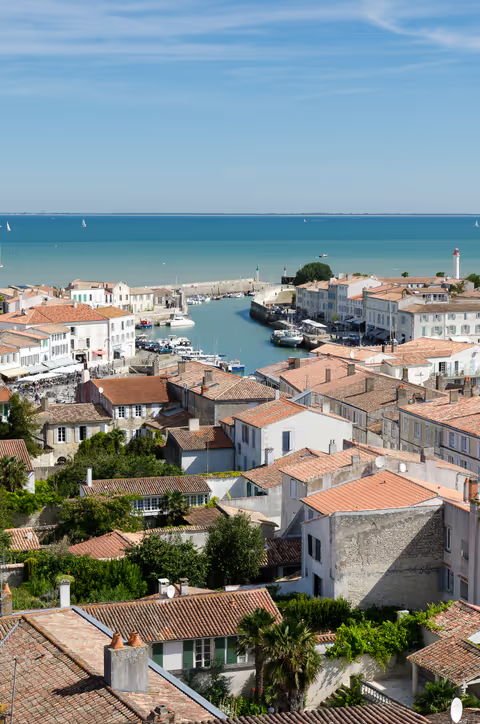
Among the jewels of the archipelago lining the Atlantic coast, the Île de Ré holds a special place. The fourth-largest island in mainland France, with a microclimate enhanced by the Gulf Stream, it attracts many loyal visitors who make it a tradition to spend their vacations there.
TheÎle de Ré is almost like a fantasy—or at least an idealized image shaped by several decades of rapid tourism growth since the bridgeconnectingitto the mainlandopened in 1988. Driven by the trend toward cycling, initiated as early as 1976 by Michel Crépeau, mayor of La Rochelle, it has become a paradise for cyclists… as well as for second homes. Yet Ré remains an island with its own unique character, way of life, and traditions. Those who live there year-round or seasonally generally know how to enjoy it with discretion. Over the decades, real estate prices there have risen considerably, approaching those of Paris’s most exclusive neighborhoods, with demand exceeding a supply that is naturally limited by a commitment to environmental preservation.
For nature lovers, Ré is a place of unspoiled beauty, offering a variety of charms. As you wander along the paths and through the fields, you’ll come across many donkeys, which serve as the island’s mascots. Every corner has its own appeal: the lively atmosphere of Saint-Martin-de-Ré and La Flotte, the peaceful tranquility of Portes-en-Ré, Loix, or Saint-Clément-des-Baleines, the unique charm of Ars-en-Ré, Bois-Plage-en-Ré, or La Couarde-sur-Mer. These ten towns are united by their white houses—which have earned the island the nickname “Ré la Blanche”—and thus preserve a shared harmony, while each cultivating its own secrets. Stretching from one to the next are some fifty kilometers of beaches, beautiful meadows, and lovely woods, such as the Trousse-Chemise woods immortalized by Aznavour, whose lyrics still strike a chord today.
Among the must-see attractions are the Les Baleines Lighthouse at the island’s northwestern tip, the Écomusée du Marais Salant in Loix, the fortifications of Saint-Martin designed by Vauban, and the Abbaye des Châteliers in La Flotte… For the food-loving traveler, there are also plenty of reasons to visit: oysters, first and foremost, as well as countless other ocean products, seaweed and glasswort, salt from the salt marshes, not to mention Charente specialties such as chaudrée—a stew of fresh fish and simmered vegetables— “éclade de moules”—mussels prepared on the beach over pine needles—or “mouclade” with its curry cream, which can be found on many tables across the island.